R410A Phase Out Tracker: The Dates, the HFC Cap and What Refrigerant Prices Did (2026)
- Primary data
- 40 CFR Part 84 (eCFR) and Federal Register EPA actions; BLS PPI WPU06790312
- Data period
- 2021 to 2026 (rules); 2019 to September 2026 (prices)
- Latest release used
- 2026-10-28
- Next release
- BLS PPI for October 2026 on 2026-11-13; EPA rule on 2029 allowances pending
- Geography
- United States
- Sources
- 32 (28 Tier 1)
The R410A phase out is not a refrigerant ban. Federal rules cut the HFC supply cap 33.6% in 2024 and have barred new R-410A equipment since 2025, though pre-2025 split inventory may be installed. Of 55 dated restrictions in 40 CFR 84.54, 29 had passed by November 2, 2026. Fluorocarbon gas producer prices rose 46.5% from 2021 to 2025.
This month in brief
- Two separate federal programs drive the R-410A transition: an allowance cap on bulk HFC production and import (40 CFR 84 subpart A) and Technology Transitions limits on new equipment (40 CFR 84.54).
- The consumption cap fell 33.6% at the 2024 step and is scheduled to fall another 50.0% on January 1, 2029, to 90,761,495 MTEVe.
- Since January 1, 2025, residential and light commercial AC and heat pumps with a GWP of 700 or more cannot be newly manufactured or imported. R-410A has an EPA-stated GWP of 2,088.
- The May 26, 2026 final rule (91 FR 31284), effective July 27, 2026, removed the deadline for installing split-system components made or imported before 2025. Between January 1 and July 26, 2026, the eCFR text did not allow those installs.
- We coded 55 dated restrictions in 40 CFR 84.54. On November 2, 2026, 29 had passed (52.7%); 6 of the 10 comfort-cooling HVAC milestones had passed.
- The BLS index that contains fluorocarbon refrigerant gases rose 46.5% from 2021 to 2025, against 17.8% for all final demand. The index is a mixed basket, not an R-410A price.
- R-454B moved from under 5% of distributor central-system sales in November 2024 to 91% in September 2025, per HARDI. EPA records that 20-lb A2L cylinders, not the chemical, ran short in 2025.
The R410A phase out is two programs: a supply cap and an equipment limit
Most confusion comes from treating one rule as a ban. The AIM Act gives EPA two levers that work on different things: a cap on how much HFC chemical can enter the U.S. market each year, and sector limits on which new equipment may use high-GWP HFCs.
The first lever is the allowance cap in 40 CFR 84.7. It limits bulk HFC production and import, measured in metric tons of exchange value equivalent (MTEVe), not in pounds. Every HFC counts against one shared cap, so R-410A competes with HFC-134a, R-404A and every other listed HFC for the same allowances.
MTEVe: Metric tons of exchange value equivalent. One metric ton of an HFC multiplied by its exchange value in Appendix A to 40 CFR Part 84. HFC-32 has an exchange value of 675 and HFC-125 has 3,500.
The second lever is the Technology Transitions rule (88 FR 73098), codified at 40 CFR 84.54. It sets a GWP limit by subsector and restricts three acts: manufacture or import of products, sale of those products after a three-year sell-through, and installation of field-assembled systems. For residential and light commercial AC and heat pumps the limit is a GWP of 700.
Technology Transitions: EPA's program under subsection (i) of the AIM Act that restricts the use of HFCs in specific sectors and subsectors, codified in 40 CFR Part 84 subpart B.
R-410A is a 50/50 blend of HFC-32 and HFC-125. EPA states its GWP as 2,088 (88 FR 73098), which matches our calculation of 2,087.5 from the 40 CFR 84.64 constituents. That puts R-410A above the 700 limit, and R-454B (GWP 465) and R-32 (GWP 675) below it.
| Refrigerant | Nominal composition | GWP used by EPA | Allowance draw per kg (MTEVe per metric ton) | Draw relative to R-410A | Status for new residential split systems |
|---|---|---|---|---|---|
| R-410A | 50% HFC-32, 50% HFC-125 | 2,088 | 2,087.5 | 1.00 | Blocked for new self-contained units and post-2024 split parts; service use and pre-2025 inventory allowed |
| R-454B | 68.9% HFC-32, 31.1% HFO-1234yf | 465 | 465.1 | 0.22 | Below the 700 limit; main replacement chosen by most U.S. OEMs per EPA |
| R-32 (HFC-32) | 100% HFC-32 | 675 | 675 | 0.32 | Below the 700 limit |
| HFO-1234yf | single component | 1 | 0 (not a listed HFC) | 0.00 | Not a regulated substance |
GWP as stated by EPA in 88 FR 73098; allowance draw computed from Appendix A exchange values and the R-454B composition in 90 FR 50766.
Source: [1][5][19] Office of the Federal Register / GPO; U.S. EPA, Federal Register; U.S. EPA, Federal Register
For an owner, the split matters: the cap affects what refrigerant costs and how much is available for service work, while the equipment limit decides what can be installed in a new system.
Which dates have passed and which are still ahead
The timeline below lists each federal action with its Federal Register citation and its status on November 2, 2026. Dates come from the Federal Register and the eCFR issue of October 28, 2026, checked against the latest amendment (91 FR 31284).
| Date | Action | Citation | What it covers | Status on 2026-11-02 |
|---|---|---|---|---|
| 2020-12-27 | AIM Act enacted | Pub. L. 116-260, Div. S, Sec. 103 | Directs EPA to cut HFC production and consumption to 15% of baseline by 2036 | in force |
| 2021-10-05 | Allowance allocation framework rule | 86 FR 55116, FR Doc 2021-21030 | Sets baselines, the step-down schedule and the allowance system in 40 CFR 84 subpart A; effective 2021-11-04 | in force, amended |
| 2021-10-07 | Notice of 2022 allowances | 86 FR 55841, FR Doc 2021-21951 | First allowances: consumption pool of 273,498,315 MTEVe for 2022 | completed |
| 2022-01-01 | First step: cap at 90% of baseline | 40 CFR 84.7 | Applies to bulk HFC production and import, not to equipment | completed |
| 2023-07-12 | Production baseline adjustment | 88 FR 44220, FR Doc 2023-14189 | Revises the production baseline to 382,535,439 MTEVe | in force |
| 2023-10-24 | Technology Transitions final rule | 88 FR 73098, FR Doc 2023-22529 | Sector GWP limits; residential and light commercial AC and heat pumps capped at GWP 700 from 2025-01-01 | in force, amended |
| 2023-12-26 | Interim final rule on residential AC inventory | 88 FR 88825, FR Doc 2023-28500 | Pre-2025 split-system components may be installed until 2026-01-01 | superseded by 91 FR 31284 |
| 2024-01-01 | Second step: cap at 60% of baseline | 40 CFR 84.7 | Consumption cap falls to 181,522,990 MTEVe for 2024 to 2028 | in force |
| 2024-10-11 | Emissions reduction and reclamation rule | 89 FR 82682, FR Doc 2024-21967 | Leak repair for 15 lb+ appliances from 2026 (residential AC excluded), reclaim standard, cylinder heel rule | in force |
| 2024-12-12 | VRF installation rule | 89 FR 100381, FR Doc 2024-29243 | Pre-2026 VRF components installable to 2027-01-01; to 2028-01-01 with a permit issued before 2023-10-05 | in force |
| 2025-01-01 | Residential AC and heat pump manufacture and install limits begin | 40 CFR 84.54(a)(1), (c)(1) | No new manufacture or import of GWP 700+ self-contained units; no new GWP 700+ split installs from post-2024 parts | in force |
| 2025-10-03 | Technology Transitions reconsideration proposal | 90 FR 47999, FR Doc 2025-19438 | Proposes removing the inventory install deadline; asks for comment on R-454B supply | finalized 2026-05-26 |
| 2025-11-14 | Comment period extended | 90 FR 51042, FR Doc 2025-19895 | Comments accepted to 2025-11-21 | completed |
| 2025-11-20 | Notice of 2026 allowances | 90 FR 52391, FR Doc 2025-20439 | Consumption pool held at 181,522,990 MTEVe | completed |
| 2026-01-01 | Inventory install deadline in eCFR text; VRF install limit begins | 40 CFR 84.54(c)(1), (c)(2) | Pre-2025 split-system inventory could no longer be installed under the text then in force | amended 2026-07-27 |
| 2026-05-26 | Technology Transitions reconsideration final rule | 91 FR 31284, FR Doc 2026-10387 | Removes the inventory install deadline; changes intermodal, cold storage, supermarket and lab dates or limits | in force since 2026-07-27 |
| 2026-05-26 | Proposal to exempt transport refrigeration units from leak repair | 91 FR 30532, FR Doc 2026-10388 | Road and intermodal TRUs; comments closed 2026-07-10 | proposed |
| 2026-07-28 | Notice of data availability on 2022 to 2025 allocation data | 91 FR 47236, FR Doc 2026-15219 | EPA says it will propose rules on issuing allowances from 2029 | open, rule to follow |
| 2026-10-06 | Notice of 2027 allowances | 91 FR 63548, FR Doc 2026-20389 | Consumption pool held at 181,522,990 MTEVe | completed |
| 2027-01-01 | VRF inventory install deadline; data center and supermarket limits | 40 CFR 84.54(c)(2), (c)(12), (c)(13) | Last day to install pre-2026 VRF components without a qualifying permit is 2026-12-31 | scheduled |
| 2028-01-01 | Sell-through ends for pre-2025 self-contained AC; cylinder heel rule | 40 CFR 84.54(b); 84.116 | No sale or distribution of GWP 700+ self-contained AC and heat pumps; used disposable cylinders sent for heel removal | scheduled |
| 2029-01-01 | Third step: cap at 30% of baseline | 40 CFR 84.7; 84.112(e) | Consumption cap falls to 90,761,495 MTEVe; reclaimed refrigerant required to service supermarkets, transport, ice makers | scheduled |
| 2034-01-01 | Fourth step: cap at 20% of baseline | 40 CFR 84.7 | Consumption cap 60,507,663 MTEVe | scheduled |
| 2036-01-01 | Final step: cap at 15% of baseline | 40 CFR 84.7 | Consumption cap 45,380,747 MTEVe | scheduled |
Coded from Federal Register documents and the eCFR issue of October 28, 2026.
Source: [1][3][5][6][7][8][9][11][17][18] Office of the Federal Register / GPO; U.S. EPA, Federal Register; U.S. EPA, Federal Register; U.S. EPA, Federal Register; U.S. EPA, Federal Register; U.S. EPA, Federal Register; U.S. EPA, Federal Register; U.S. EPA, Federal Register; U.S. EPA, Federal Register; U.S. EPA, Federal Register
Three dates have changed since the 2023 rule for HVAC work: the residential inventory install deadline (added in December 2023, removed effective July 27, 2026), the VRF install date (extended by 89 FR 100381), and several commercial refrigeration limits. Every other residential date from the 2023 rule still stands.
The next residential dates are January 1, 2027, the last install date for pre-2026 VRF components without a qualifying permit (89 FR 100381), and January 1, 2028, when pre-2025 self-contained units such as window and packaged terminal units can no longer be sold or distributed. That is 425 days after this update.
29 of 55 dated restrictions are already in force
We coded every dated restriction in 40 CFR 84.54 as of the October 28, 2026 eCFR issue, one row per enumerated paragraph, and checked each date against November 2, 2026. Just over half are in force; the rest run to 2032.
Dated restrictions in 40 CFR 84.54 by compliance year and action
Source: our coding of 40 CFR 84.54 (eCFR, issue 2026-10-28).
| Compliance year | Manufacture or import | Install | Sell or distribute | Total | Status on 2026-11-02 |
|---|---|---|---|---|---|
| 2024 | 1 | 0 | 0 | 1 | passed |
| 2025 | 10 | 4 | 0 | 14 | passed |
| 2026 | 6 | 8 | 0 | 14 | passed |
| 2027 | 4 | 4 | 0 | 8 | ahead |
| 2028 | 6 | 2 | 2 | 10 | ahead |
| 2030 | 2 | 3 | 0 | 5 | ahead |
| 2032 | 0 | 3 | 0 | 3 | ahead |
Counts from table t4; one milestone with a model-year trigger is excluded.
Source: [1] Office of the Federal Register / GPO
Of 55 dated milestones, 29 had passed on November 2, 2026, or 52.7%. The years 2025 and 2026 each carried 14 milestones. The year 2028 carries 10 more, including the end of sell-through for pre-2025 self-contained AC and dehumidifiers.
For comfort-cooling HVAC (residential and light commercial AC and heat pumps, dehumidifiers, VRF, comfort chillers and data center cooling), 6 of 10 milestones have passed. Adding commercial refrigeration systems that HVACR contractors also service, 7 of 16 have passed.
The May 2026 reconsideration rule touched 15 of the coded rows, mostly in commercial and industrial refrigeration. Owners with refrigeration service lines should read their subsector rows rather than rely on the residential dates.
Show all 56 rows
| eCFR paragraph | Action restricted | Subsector and limit | Compliance date | Trade group | Status on 2026-11-02 | Amendment note |
|---|---|---|---|---|---|---|
| 84.54(a)(1) | manufacture/import | Self-contained residential and light commercial AC and heat pumps, GWP 700+ | 2025-01-01 | HVAC | passed | |
| 84.54(a)(2) | manufacture/import | Residential dehumidifiers, GWP 700+ | 2025-01-01 | HVAC | passed | |
| 84.54(a)(3) | manufacture/import | Household refrigerators and freezers, GWP 150+ | 2025-01-01 | other | passed | |
| 84.54(a)(4) | manufacture/import | Retail food stand-alone units, GWP 150+ | 2025-01-01 | other | passed | |
| 84.54(a)(5) | manufacture/import | Vending machines, GWP 150+ | 2025-01-01 | other | passed | |
| 84.54(a)(6) | manufacture/import | Intermodal containers, GWP 700+ | 2026-07-27 | other | passed | amended by 91 FR 31284 |
| 84.54(a)(7) | manufacture/import | Self-contained road and marine transport refrigeration, listed HFCs | 2025-01-01 | other | passed | |
| 84.54(a)(8)(i) | manufacture/import | Self-contained ice machines, smaller harvest rates, GWP 150+ | 2026-01-01 | other | passed | |
| 84.54(a)(8)(ii) | manufacture/import | Self-contained ice machines, larger harvest rates, listed HFCs incl. R-410A | 2027-01-01 | other | ahead | |
| 84.54(a)(9)(i) | manufacture/import | Food processing and dispensing, charge 500 g or less, GWP 150+ | 2027-01-01 | other | ahead | |
| 84.54(a)(9)(ii) | manufacture/import | Food processing and dispensing, charge over 500 g, listed HFCs | 2027-01-01 | other | ahead | |
| 84.54(a)(9)(iii) | manufacture/import | Ice cream makers in UL 621 scope, listed HFCs | 2028-01-01 | other | ahead | |
| 84.54(a)(10)(i) | manufacture/import | Comfort cooling chillers, GWP 700+ | 2025-01-01 | HVAC | passed | |
| 84.54(a)(10)(ii) | manufacture/import | Ice rink chillers, GWP 700+ | 2025-01-01 | other | passed | |
| 84.54(a)(10)(iii) | manufacture/import | Industrial process chillers above -30 C, GWP 700+ | 2026-01-01 | other | passed | |
| 84.54(a)(10)(iv) | manufacture/import | Industrial process chillers -50 C to -30 C, GWP 700+ | 2028-01-01 | other | ahead | |
| 84.54(a)(10)(v) | manufacture/import | Semiconductor process chillers 100 lb or less | 2030-01-01 | other | ahead | amended by 91 FR 31284 |
| 84.54(a)(11) | manufacture/import | Self-contained data center and computer room cooling, GWP 700+ | 2027-01-01 | HVAC | ahead | |
| 84.54(a)(12)(i) | manufacture/import | Industrial process refrigeration 200 lb+, GWP 150+ | 2026-01-01 | other | passed | |
| 84.54(a)(12)(ii) | manufacture/import | Industrial process refrigeration under 200 lb, GWP 300+ | 2026-01-01 | other | passed | |
| 84.54(a)(12)(iii) | manufacture/import | Industrial process refrigeration -50 C to -30 C, GWP 700+ | 2028-01-01 | other | ahead | |
| 84.54(a)(12)(iv) | manufacture/import | Semiconductor process refrigeration 100 lb or less | 2030-01-01 | other | ahead | amended by 91 FR 31284 |
| 84.54(a)(12)(v) | manufacture/import | Laboratory centrifuges and shaker tables | 2028-01-01 | other | ahead | amended by 91 FR 31284 |
| 84.54(a)(13)(i) | manufacture/import | Light-duty vehicle AC, model year 2025+, GWP 150+ | 2024-10-24 | other | passed | |
| 84.54(a)(13)(ii) | manufacture/import | Medium-duty and heavy-duty pickup AC, model year 2028+ | model year 2028 | other | no calendar date | model-year trigger, no calendar date |
| 84.54(a)(13)(iii) | manufacture/import | Nonroad vehicle AC, GWP 150+ | 2028-01-01 | other | ahead | |
| 84.54(a)(14) | manufacture/import | Foam products (8 foam subsectors), GWP 150+ | 2025-01-01 | other | passed | |
| 84.54(a)(15) | manufacture/import | Space and military foam | 2026-01-01 | other | passed | |
| 84.54(a)(16)(i) | manufacture/import | Aerosols, GWP 150+, with listed exceptions | 2025-01-01 | other | passed | |
| 84.54(a)(16)(ii) | manufacture/import | Aerosols, remaining exceptions end | 2028-01-01 | other | ahead | |
| 84.54(b) for (a)(1) | sell/distribute | Pre-2025 self-contained residential and light commercial AC and heat pumps, GWP 700+ | 2028-01-01 | HVAC | ahead | three years after (a)(1) |
| 84.54(b) for (a)(2) | sell/distribute | Pre-2025 residential dehumidifiers, GWP 700+ | 2028-01-01 | HVAC | ahead | three years after (a)(2) |
| 84.54(c)(1) | install | Residential and light commercial split AC and heat pump systems, GWP 700+ (pre-2025 components exempt, no end date) | 2025-01-01 | HVAC | passed | inventory end date removed by 91 FR 31284 |
| 84.54(c)(2) | install | Residential and light commercial VRF systems, GWP 700+ | 2026-01-01 | HVAC | passed | carve-outs to 2027 and 2028 per 89 FR 100381 |
| 84.54(c)(3) | install | Comfort cooling chillers, GWP 700+ | 2025-01-01 | HVAC | passed | |
| 84.54(c)(4) | install | Ice rinks, GWP 700+ | 2025-01-01 | other | passed | |
| 84.54(c)(5)(i) | install | Industrial process chillers above -30 C, GWP 700+ | 2026-01-01 | other | passed | |
| 84.54(c)(5)(ii) | install | Semiconductor process chillers 100 lb or less | 2030-01-01 | other | ahead | amended by 91 FR 31284 |
| 84.54(c)(6)(i) | install | Industrial process chillers -50 C to -30 C, GWP 700+ | 2028-01-01 | other | ahead | |
| 84.54(c)(6)(ii) | install | Semiconductor process chillers -50 C to -30 C, 100 lb or less | 2030-01-01 | other | ahead | amended by 91 FR 31284 |
| 84.54(c)(7) | install | Intermodal containers, GWP 700+ | 2026-07-27 | other | passed | amended by 91 FR 31284 |
| 84.54(c)(8) | install | Road and marine transport refrigeration, listed HFCs | 2025-01-01 | other | passed | |
| 84.54(c)(9)(i) | install | Cold storage warehouses, GWP 700+ | 2026-07-27 | other | passed | amended by 91 FR 31284 |
| 84.54(c)(9)(ii) | install | Cold storage warehouses, GWP 150 or 300 | 2032-01-01 | other | ahead | amended by 91 FR 31284 |
| 84.54(c)(10)(i) | install | Industrial process refrigeration 200 lb+, GWP 150+ | 2026-01-01 | other | passed | |
| 84.54(c)(10)(ii) | install | Industrial process refrigeration under 200 lb, GWP 300+ | 2026-01-01 | other | passed | |
| 84.54(c)(10)(iii) | install | High-temperature side of cascade systems, GWP 300+ | 2026-01-01 | other | passed | |
| 84.54(c)(10)(iv) | install | Industrial process refrigeration -50 C to -30 C, GWP 700+ | 2028-01-01 | other | ahead | |
| 84.54(c)(10)(v) | install | Semiconductor process refrigeration 100 lb or less | 2030-01-01 | other | ahead | amended by 91 FR 31284 |
| 84.54(c)(11)(i) | install | Retail food remote condensing units, GWP 1,400+ | 2026-07-27 | HVACR | passed | amended by 91 FR 31284 |
| 84.54(c)(11)(ii) | install | Retail food remote condensing units, GWP 150 or 300 | 2032-01-01 | HVACR | ahead | amended by 91 FR 31284 |
| 84.54(c)(12)(i) | install | Supermarket systems, GWP 1,400+ | 2027-01-01 | HVACR | ahead | amended by 91 FR 31284 |
| 84.54(c)(12)(ii) | install | Supermarket systems, GWP 150 or 300 | 2032-01-01 | HVACR | ahead | amended by 91 FR 31284 |
| 84.54(c)(13) | install | Data center and computer room cooling systems, GWP 700+ | 2027-01-01 | HVAC | ahead | |
| 84.54(c)(14) | install | Ice machines with remote condenser, listed HFCs | 2027-01-01 | HVACR | ahead | |
| 84.54(c)(15) | install | Food processing and dispensing with remote condenser, listed HFCs | 2027-01-01 | HVACR | ahead |
One row per enumerated paragraph. Sell-through rows under 84.54(b) coded for the two residential HVAC products only. Trade group is our classification.
Source: [1][11] Office of the Federal Register / GPO; U.S. EPA, Federal Register
Pre-2025 R-410A split systems can be installed again, after a 207-day gap
The inventory carve-out for residential split systems changed three times in three years. For part of 2026 the regulatory text did not allow installing even legally made pre-2025 equipment.
The 2023 rule barred installing new residential and light commercial split systems with a GWP of 700 or more from January 1, 2025. Two months later the interim final rule (88 FR 88825) let systems be installed until January 1, 2026, if every specified component was made in or imported into the U.S. before January 1, 2025.
That deadline arrived before EPA finished reconsidering it. EPA proposed removing it on October 3, 2025 (90 FR 47999) and considered a one-year extension to January 1, 2027 as an alternative. The final rule (91 FR 31284) removed the deadline and took effect July 27, 2026.
Comparing eCFR point-in-time versions, the January 1, 2026 cut-off sat in 40 CFR 84.54(c)(1) through July 26, 2026. That is 207 days in which the text did not allow installing pre-2025 R-410A split inventory. We found no Federal Register notice of enforcement discretion for this subsector; EPA did issue no action assurances for intermodal containers and certain industrial process refrigeration equipment, per the final rule's footnotes.
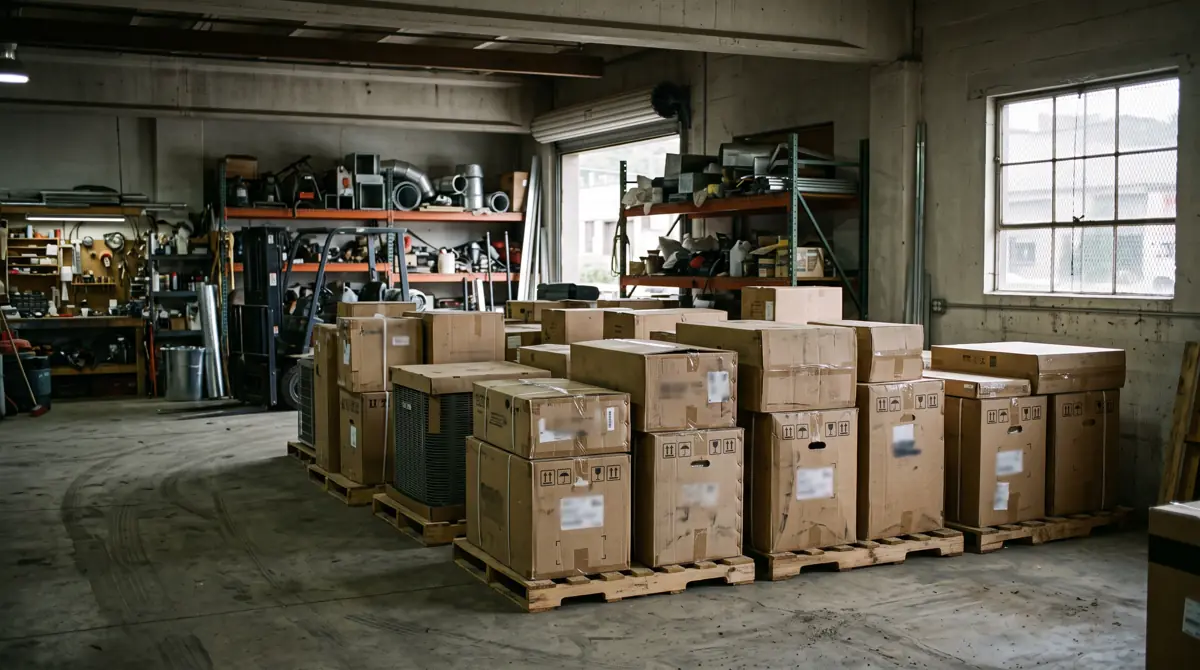
The final rule says the remaining stock is finite and shrinking, because no new GWP 700+ components may be made or imported for new systems. Components made in Canada or Mexico qualify only if they were imported into the U.S. before January 1, 2025.
For a contractor holding R-410A condensers and coils, the practical record is the manufacture or import date of each component. That date, not the purchase date, decides whether the unit can go into a new system.
The cap fell by a third in 2024 and halves again in 2029
The allowance cap is set in exchange-value tonnes for all HFCs together. EPA has issued allowances for every year through 2027, all at the levels in 40 CFR 84.7.
National consumption cap, million MTEVe, by year
Source: 40 CFR 84.7 (eCFR, issue 2026-10-28); EPA allowance notices 2022 to 2027.
| Year | Percent of baseline | Production cap (MTEVe) | Consumption cap (MTEVe) | Consumption cap (million MTEVe) | Source | Status |
|---|---|---|---|---|---|---|
| 2022 | 90 | 344,299,157 | 273,498,315 | 273.5 | 86 FR 55841 (2021-21951) | allowances issued |
| 2023 | 90 | 344,299,157 | 273,498,315 | 273.5 | 87 FR 61314 (2022-22059) | allowances issued |
| 2024 | 60 | 229,521,263 | 181,522,990 | 181.5 | 88 FR 72060 (2023-22163) | allowances issued |
| 2025 | 60 | 229,521,263 | 181,522,990 | 181.5 | 89 FR 84583 (2024-24444) | allowances issued |
| 2026 | 60 | 229,521,263 | 181,522,990 | 181.5 | 90 FR 52391 (2025-20439) | allowances issued |
| 2027 | 60 | 229,521,263 | 181,522,990 | 181.5 | 91 FR 63548 (2026-20389) | allowances issued |
| 2028 | 60 | 229,521,263 | 181,522,990 | 181.5 | 40 CFR 84.7(b)(3) | scheduled in 40 CFR 84.7 |
| 2029 | 30 | 114,760,632 | 90,761,495 | 90.8 | 40 CFR 84.7(b)(3) | scheduled in 40 CFR 84.7 |
| 2030 | 30 | 114,760,632 | 90,761,495 | 90.8 | 40 CFR 84.7(b)(3) | scheduled in 40 CFR 84.7 |
| 2031 | 30 | 114,760,632 | 90,761,495 | 90.8 | 40 CFR 84.7(b)(3) | scheduled in 40 CFR 84.7 |
| 2032 | 30 | 114,760,632 | 90,761,495 | 90.8 | 40 CFR 84.7(b)(3) | scheduled in 40 CFR 84.7 |
| 2033 | 30 | 114,760,632 | 90,761,495 | 90.8 | 40 CFR 84.7(b)(3) | scheduled in 40 CFR 84.7 |
| 2034 | 20 | 76,507,088 | 60,507,663 | 60.5 | 40 CFR 84.7(b)(3) | scheduled in 40 CFR 84.7 |
| 2035 | 20 | 76,507,088 | 60,507,663 | 60.5 | 40 CFR 84.7(b)(3) | scheduled in 40 CFR 84.7 |
| 2036 | 15 | 57,380,316 | 45,380,747 | 45.4 | 40 CFR 84.7(b)(3) | scheduled in 40 CFR 84.7 |
40 CFR 84.7(b)(3). The 2022 to 2023 figures reflect the baselines in force when they were set. Allowances issued through 2027.
Source: [1][12][13][14][15][16][17] Office of the Federal Register / GPO; U.S. EPA, Federal Register; U.S. EPA, Federal Register; U.S. EPA, Federal Register; U.S. EPA, Federal Register; U.S. EPA, Federal Register; U.S. EPA, Federal Register
The 2024 step removed 91,975,325 MTEVe of annual consumption allowances, a 33.6% cut from the 2022 to 2023 level. The 2029 step removes half of what is left. From the first cap to the 2029 cap, the total falls 66.8%.
To make the cap concrete, we converted it to R-410A tonnes. If the entire 2024 to 2028 consumption cap were spent on R-410A, it would cover 86,957 metric tons; the 2029 cap would cover 43,479. Spent only on the HFC-32 in R-454B, the current cap would cover 390,309 metric tons of R-454B, because each kilogram of R-410A draws 4.49 times the allowances of R-454B.
These conversions are illustrations. The cap covers every HFC use in the country, and EPA does not assign allowances by refrigerant. EPA's July 2026 notice (91 FR 47236) says a rule on issuing allowances from 2029 is coming; the scheduled percentages are set by statute.
Fluorocarbon gas producer prices rose 46.5% from 2021 to 2025
The only free official price series that captures refrigerant gases is the BLS producer price index for other industrial gases, including fluorocarbons. It moved most sharply just before the first cap, and again through 2025.
Annual averages, 2021 = 100; 2026 is January to September
Source: BLS Producer Price Index flat files, release of 2026-10-15. Our rebasing.
From the BLS PPI flat files, series WPU06790312 averaged 217.578 in 2021, the last year without a cap, and 318.764 in 2025, a 46.5% rise. PPI final demand rose 17.8% over the same years, so the gas index gained 24.4% relative to producer prices generally. The industry-based twin, PCU325120325120T, moved from 219.293 to 321.278 and tells the same story.
The sharpest move came before the cap began. The index rose 23.7% from October 2021 (213.837) to December 2021 (264.554), the window after EPA issued the first allowances on October 7, 2021. September 2026 reads 342.098, preliminary, which is 57.2% above the 2021 average.
2022 versus 2025. Cap in percent of baseline; price indexes 2021 = 100
Source: 40 CFR 84.7; BLS PPI WPU06790312 and WPUFD4. Our calculations.
Across the 2024 step, from the 2023 average to the 2025 average, the index rose 17.9%. Measured from 2022 to 2025, while the cap went from 90% to 60% of baseline, the index rose 16.7%, or 0.56% per percentage point of cap cut. From 2021, the ratio is 1.16% per point.
| Period | PPI other industrial gases incl. fluorocarbons (WPU06790312) | PPI industry cross-check (PCU325120325120T) | PPI final demand (WPUFD4) | Gas index, 2021=100 | Final demand, 2021=100 | Gas relative to final demand, 2021=100 | Note |
|---|---|---|---|---|---|---|---|
| 2019 | 219.400 | 221.100 | 118.200 | 100.8 | 93.3 | 108.1 | annual average |
| 2020 | 208.100 | 209.800 | 118.400 | 95.6 | 93.4 | 102.4 | annual average |
| 2021 | 217.578 | 219.293 | 126.710 | 100.0 | 100.0 | 100.0 | annual average |
| 2022 | 273.185 | 275.340 | 138.753 | 125.6 | 109.5 | 114.7 | annual average |
| 2023 | 270.351 | 272.483 | 141.549 | 124.3 | 111.7 | 111.2 | annual average |
| 2024 | 283.001 | 285.233 | 144.885 | 130.1 | 114.3 | 113.8 | annual average |
| 2025 | 318.764 | 321.278 | 149.219 | 146.5 | 117.8 | 124.4 | annual average |
| 2026 Jan-Sep | 345.530 | 348.254 | 156.173 | 158.8 | 123.3 | 128.8 | 9-month average; Jun-Sep preliminary |
BLS release of October 15, 2026. M13 annual averages; 2026 is the January to September mean, June to September preliminary.
Source: [21][22][23] U.S. Bureau of Labor Statistics; U.S. Bureau of Labor Statistics; U.S. Bureau of Labor Statistics
Treat these as direction, not as an R-410A price. The BLS item mixes fluorocarbons with acetylene and other gases, reflects producer prices rather than what a contractor pays at the counter, and cannot separate the cap from energy, feedstock or trade costs. Distributor price lists are not used here.
R-454B took over in under a year, and cylinders, not chemical, ran short
The equipment changeover ran faster than the rules required. EPA's own record says the 2025 R-454B shortage was a packaging and distribution problem at the contractor level.
A2L share of central ducted system sales, HARDI distributor panel
Source: HARDI press releases of June 11, 2025 and November 19, 2025 (Tier 2, panel data). November 2024 share reported only as less than 5%.
HARDI's distributor panel put A2L equipment at less than 5% of central ducted sales in November 2024, 51% in April 2025 and 60% in preliminary May data (HARDI, June 11, 2025). By September 2025 the share was 91% (HARDI, November 19, 2025). HARDI's November headline says 90%; the body says 91%. These are trade association panel figures, not audited totals.
EPA's October 2025 proposal (90 FR 47999) describes why R-454B was hard to find: a shortage of 20-lb cylinders rated for A2L refrigerants limited supply to contractors through the spring and most of summer 2025. EPA notes that equipment makers, which buy refrigerant in isotanks, were much less exposed, that most U.S. OEMs chose R-454B, and that one chemical producer announced an R-454B surcharge in April 2025.
The final rule repeats the point: supply of R-454B was sufficient, but supplying it in service cylinders was not, which produced regional scarcity. EPA used that record to justify letting pre-2025 R-410A inventory be installed.
Percent change in producer price index, December 2024 to latest month
Source: BLS PPI machinery flat file, release of 2026-10-15. Latest months preliminary.
| Series | Product | Dec 2022 | Dec 2024 | Latest month | Latest value | Change Dec 2022 to Dec 2024 (%) | Change Dec 2024 to latest (%) |
|---|---|---|---|---|---|---|---|
| WPU1148 | Air conditioning and refrigeration equipment | 282.556 | 297.331 | 2026-09 | 327.702 | 5.2 | 10.2 |
| WPU114802 | Unitary air conditioners, except air source heat pumps | 253.126 | 272.438 | 2026-09 | 303.868 | 7.6 | 11.5 |
| WPU11480734 | Heat pumps | 141.766 | 144.713 | 2026-09 | 141.932 | 2.1 | -1.9 |
| WPU114815 | Refrigeration condensing units | 155.544 | 159.721 | 2026-08 | 165.972 | 2.7 | 3.9 |
BLS machinery flat file, release of October 15, 2026. Latest months preliminary. Index bases differ by series.
Source: [24] U.S. Bureau of Labor Statistics
Equipment producer prices split after the January 2025 manufacture cutoff. The unitary air conditioner index rose 11.5% from December 2024 to September 2026 (preliminary), and the broad AC and refrigeration equipment index rose 10.2%. The heat pump index fell 1.9%. The data cannot say how much of the AC increase reflects the refrigerant change; shipments are covered in our heat pump sales report.
What the rules leave alone: repairs, condensing units and service refrigerant
Nothing in 40 CFR Part 84 requires an existing R-410A system to be removed. The rules touch servicing at the edges: refrigerant supply, reclaim standards and cylinder disposal.
The final rule (91 FR 31284) left the treatment of replacement condensing units unchanged. Condensing units are one of five specified components that may still be made, imported and sold so owners can maintain existing systems that use legacy HFCs. Installing them as a new system after the deadline stays prohibited.
- Leak repair (40 CFR 84.106) applies from January 1, 2026 to appliances with 15 lb or more of HFC refrigerant, and excludes the residential and light commercial AC and heat pump subsector.
- Since January 1, 2026, refrigerant sold as reclaimed may contain no more than 15% virgin HFC by weight (40 CFR 84.112(a)).
- From January 1, 2028, used disposable cylinders must go for heel removal, or a certified technician must evacuate them to 15 in-Hg and sign a statement (40 CFR 84.116).
- From January 1, 2029, servicing supermarket systems, refrigerated transport and automatic commercial ice makers must use reclaimed refrigerant (40 CFR 84.112(e)). Residential AC is not on that list.
The cost side of servicing runs through the cap. Allowance holders can still produce or import the HFC-32 and HFC-125 that make up R-410A, and each kilogram of R-410A draws 4.49 times the allowances of R-454B. As the cap halves in 2029, service refrigerant competes for a smaller pool.
What the dates mean for a contractor's stock and service book
For a company owner, the rules translate into three records worth keeping current: component manufacture dates, the mix of R-410A service work, and refrigerant purchase costs.
Stock: pre-2025 split-system components can be installed with no end date, but pre-2025 self-contained units cannot be sold after January 1, 2028, and pre-2026 VRF components face January 1, 2027. A dated inventory list by component shows which stock is still usable.
Service book: existing R-410A systems can be repaired for their full life under current rules, and replacement condensing units remain on the market. The supply of refrigerant for that work is set by the cap, which steps down on January 1, 2029, 791 days after this update.
Costs: the BLS fluorocarbon gas index is 57.2% above its 2021 average as of September 2026 (preliminary). Comparing a company's own refrigerant cost per job with that index shows whether its pricing kept pace. Our main guide for owners selling an HVAC company covers the sale process itself.
Momentum and share analysis
Dated 40 CFR 84.54 milestones passed as of 2026-11-02 (SIGNATURE)
Formulacount(compliance date <= 2026-11-02) / count(dated milestones)
Inputs: table t4 (fact sheet rows)
Result: 29 of 55 milestones
Signature figure. Just over half of all dated restrictions are already in force; the remaining 26 run from 2027 to 2032.
Limitations: One row per enumerated paragraph; (b) sell-through rows coded only for the two residential HVAC products.
Days the eCFR barred installing pre-2025 R-410A split inventory
Formula2026-07-27 minus 2026-01-01
Inputs: rows 7, 8, 9 (fact sheet rows)
Result: 207 days
Signature figure. For 207 days the published regulation did not allow installing legally made pre-2025 split inventory.
Limitations: Regulatory text only; no EPA enforcement statement for this subsector was found in the Federal Register.
Comfort-cooling HVAC milestones passed as of 2026-11-02
Formulacount(HVAC rows passed) / count(HVAC rows)
Inputs: table t4 (fact sheet rows)
Result: 6 of 10 milestones
Most comfort-cooling dates are behind the industry; the four ahead are the 2027 data center cooling manufacture and install limits and the two 2028 sell-through dates.
Limitations: HVAC = residential and light commercial AC/HP, dehumidifiers, VRF, comfort chillers, data center cooling.
Consumption cap cut at the 2024 step
Formula(cap 2024-2028 / cap 2022-2023 - 1) x 100
Inputs: rows 3, 4 (fact sheet rows)
Result: -33.6 percent
The first cut that bit was 2024; 2022 and 2023 ran at 90% of baseline.
Limitations: Caps are in exchange-value tonnes across all 18 listed HFCs, not pounds of R-410A.
Cumulative consumption cap cut, 2022 cap to 2029 cap
Formula(cap 2029-2033 / cap 2022-2023 - 1) x 100
Inputs: rows 3, 5 (fact sheet rows)
Result: -66.8 percent
By 2029 the allowed total is one third of the first cap.
Limitations: Compares the first cap with the cap scheduled from 2029.
Refrigerant gas PPI change, 2021 average to 2025 average
Formula(WPU06790312 2025 avg / 2021 avg - 1) x 100
Inputs: rows 20, 21 (fact sheet rows)
Result: 46.5 percent
The gas index rose faster than producer prices generally.
Limitations: Index covers other industrial gases including fluorocarbons and acetylene; not an R-410A price.
Refrigerant gas PPI change relative to final demand, 2021 to 2025
Formula((gas 2025/gas 2021) / (FD 2025/FD 2021) - 1) x 100
Inputs: rows 20, 21, 22, 23 (fact sheet rows)
Result: 24.4 percent
Relative price gain after removing economy-wide producer inflation.
Limitations: Deflating by final demand is a relative-price measure, not a consumer inflation adjustment.
Refrigerant gas PPI jump before the first cap, Oct 2021 to Dec 2021
Formula(Dec 2021 / Oct 2021 - 1) x 100
Inputs: rows 24, 25 (fact sheet rows)
Result: 23.7 percent
Most of the early move came before the first cap year began.
Limitations: Timing matches the 2022 allowance notice (Oct 7, 2021); correlation, not proven cause.
Price rise per percentage point of cap cut, 2021 to 2025
Formulad5 / (100 - 60), where 60 is the 2024-2028 cap as percent of baseline
Inputs: rows 2, 20, 21 (fact sheet rows)
Result: 1.16 percent per point
Descriptive ratio linking the price move to the size of the cap cut since the last uncapped year.
Limitations: Descriptive ratio only; it does not isolate the cap from other price drivers.
Price rise per percentage point of cap cut, 2022 to 2025
Formulad27 / (90 - 60)
Inputs: rows 2, 21, 67 (fact sheet rows)
Result: 0.56 percent per point
Same ratio inside the capped period; smaller because much of the price move came in late 2021.
Limitations: Descriptive ratio only.
Allowance use per kg, R-410A versus R-454B
Formula2,087.5 / (0.689 x 675)
Inputs: rows 10, 12, 13 (fact sheet rows)
Result: 4.49 ratio
Why the cap pushes the market toward R-454B: each kilogram uses about a fifth of the allowances.
Limitations: HFO-1234yf in R-454B carries no exchange value, so only the HFC-32 share draws allowances.
2024-2028 consumption cap if spent only on R-410A
Formula181,522,990 / 2,087.5
Inputs: rows 4, 10, 11 (fact sheet rows)
Result: 86,957 metric tons
Illustration of the cap's size in refrigerant terms.
Limitations: Illustration only: the cap covers every HFC use, not just AC refrigerant.
Unitary AC PPI change since the Jan 2025 manufacture cutoff
Formula(Sep 2026 / Dec 2024 - 1) x 100
Inputs: rows 28, 29 (fact sheet rows)
Result: 11.5 percent
AC equipment producer prices rose after the January 2025 manufacture cutoff.
Limitations: Producer prices for unitary AC excluding heat pumps; Sep 2026 preliminary; mix of R-454B and R-32 units unknown.
Findings to track
- The national HFC consumption cap was 273,498,315 MTEVe in 2022 and 2023 and 181,522,990 MTEVe from 2024 to 2028, a 33.6% cut (40 CFR 84.7).[1][12][14]
- The cap is scheduled to drop to 90,761,495 MTEVe on January 1, 2029, a further 50.0% cut, and to 45,380,747 MTEVe from 2036 (40 CFR 84.7).[1]
- From the 2022 cap to the 2029 cap, allowed U.S. HFC consumption falls 66.8% in exchange-value terms (our calculation from 40 CFR 84.7).[1]
- Since January 1, 2025, no self-contained residential or light commercial AC or heat pump with a GWP of 700 or more may be manufactured or imported in the U.S. (40 CFR 84.54(a)(1)).[1][5]
- Sale and distribution of those pre-2025 self-contained units ends January 1, 2028, three years after the manufacture date (40 CFR 84.54(b)).[1]
- The December 2023 interim final rule allowed pre-2025 split-system components to be installed until January 1, 2026 (88 FR 88825).[6]
- The final rule published May 26, 2026 removed that installation deadline, effective July 27, 2026 (91 FR 31284).[11]
- Our count: the eCFR text barred installing pre-2025 R-410A split inventory for 207 days in 2026, from January 1 through July 26. No EPA enforcement statement for this subsector appears in the Federal Register.[2][11]
- Of 55 dated restrictions coded from 40 CFR 84.54 as of the October 28, 2026 eCFR issue, 29 had passed on November 2, 2026 (52.7%).[1]
- The May 2026 rule changed the date, limit or carve-out on 15 of the coded milestone rows (91 FR 31284).[11]
- The BLS producer price index for other industrial gases including fluorocarbons averaged 217.578 in 2021 and 318.764 in 2025, a 46.5% rise (WPU06790312).[21]
- The same index jumped 23.7% between October 2021 and December 2021, the months between the first allowance notice (October 7, 2021) and the first cap year.[21][12]
- Relative to PPI final demand, the fluorocarbon gas index rose 24.4% from 2021 to 2025 (our calculation from WPU06790312 and WPUFD4).[21][23]
- HARDI reported A2L equipment at 91% of distributor central-system sales in September 2025, up from less than 5% in November 2024.[28][29]
- The producer price index for unitary air conditioners rose 11.5% from December 2024 to September 2026 (preliminary), while the heat pump index fell 1.9%.[24]
Questions people ask
Is R-410A being banned?
No. Federal rules cap total HFC supply and restrict new equipment, but no rule in 40 CFR Part 84 bans the refrigerant or existing systems. Since January 1, 2025, new self-contained AC and heat pumps above GWP 700 cannot be made or imported; R-410A's GWP is 2,088 (88 FR 73098).
Can I still buy R-410A?
Yes. Nothing in 40 CFR Part 84 bans selling R-410A refrigerant. Allowance holders can still produce or import its components, HFC-32 and HFC-125, within the national cap of 181,522,990 MTEVe for 2024 to 2028 (40 CFR 84.7). The cap falls to 90,761,495 MTEVe on January 1, 2029. The equipment rules in 40 CFR 84.54 restrict products and installations, not service refrigerant.
Can I still install an R-410A system?
Only if every specified component was made in or imported into the U.S. before January 1, 2025. Since July 27, 2026 that carve-out has no end date (91 FR 31284). Between January 1 and July 26, 2026 the eCFR text did not allow it. VRF has its own January 1, 2027 deadline. Confirm specific jobs with EPA or an attorney.
What replaces R-410A?
For residential split systems, mainly R-454B (GWP 465), with some R-32 (GWP 675), both below the 700 limit (88 FR 73098). EPA says most U.S. OEMs chose R-454B. HARDI reported A2L equipment at 91% of distributor central-system sales in September 2025.
Why is R-454B hard to find?
EPA's October 2025 proposal (90 FR 47999) attributes the 2025 shortage to a lack of 20-lb cylinders rated for A2L refrigerants, demand above forecasts and some stockpiling. The final rule says the chemical supply was sufficient but service cylinders for contractors were not.
What does the phase-down mean for existing systems?
Existing R-410A systems can be repaired for their full life, and replacement condensing units remain on the market (91 FR 31284). Residential AC is excluded from the 2026 leak repair rule. The pressure comes through refrigerant supply: the cap halves on January 1, 2029.
Download the data
Every table in this report is available as a CSV under CC BY 4.0. The fact sheet lists each value with its source URL and access date.
- derived_metrics.csv (CSV)
- fact_sheet.csv (CSV)
- t1_timeline.csv (CSV)
- t2_cap.csv (CSV)
- t3_ppi.csv (CSV)
- t4_milestones.csv (CSV)
- t5_equipment_ppi.csv (CSV)
- t6_refrigerants.csv (CSV)
- t7_milestones_by_year.csv (CSV)
For journalists and researchers
If you cite only a few, cite these
- 29 of 55 dated restrictions in 40 CFR 84.54 were in force on November 2, 2026.[1]
- The eCFR text barred installing pre-2025 R-410A split inventory for 207 days in 2026.[2][11]
- Fluorocarbon gas producer prices rose 46.5% from 2021 to 2025 (BLS WPU06790312).[21]
Most quotable statistics
- The national HFC consumption cap fell 33.6% at the 2024 step, from 273,498,315 to 181,522,990 MTEVe, and falls another 50.0% on January 1, 2029 (40 CFR 84.7).[1]
- Of 55 dated HFC use restrictions in 40 CFR 84.54, 29 had passed on November 2, 2026, by HVAC Business Brokers Research Desk coding.[1]
- For 207 days in 2026, from January 1 through July 26, the federal regulation did not allow installing pre-2025 R-410A split-system inventory; a May 2026 rule removed that deadline.[2][11]
- The BLS producer price index for fluorocarbon and other industrial gases rose 46.5% from 2021 to 2025, against 17.8% for all final demand.[21][23]
- The same index jumped 23.7% from October to December 2021, after EPA issued the first HFC allowances and before the first cap year began.[21][12]
- A2L equipment reached 91% of distributor central-system sales in September 2025, up from less than 5% in November 2024, per HARDI.[28][29]
Press summary
A new tracker from the HVAC Business Brokers Research Desk finds that the R-410A phase out is narrower than "banned" suggests, and further along than many owners assume. Coding every dated restriction in 40 CFR 84.54, the desk counts 55 milestones, of which 29 had passed by November 2, 2026. For residential split systems, the eCFR text barred installing even pre-2025 R-410A inventory for 207 days in 2026, until an EPA final rule published May 26 removed the deadline effective July 27. The national HFC consumption cap fell 33.6% in 2024 and is scheduled to fall another 50.0% on January 1, 2029. Over the same period the Bureau of Labor Statistics producer price index that includes fluorocarbon refrigerants rose 46.5% from 2021 to 2025, compared with 17.8% for all final demand. EPA's own record attributes the 2025 R-454B shortage to service cylinders rather than chemical supply. The data and code are published under CC BY 4.0.
Suggested headlines
- 29 of 55 Federal HFC Restriction Dates Have Now Passed
- For 207 Days in 2026, Pre-2025 R-410A Systems Could Not Legally Be Installed
- HFC Cap Cut by a Third in 2024, Halves Again in 2029
- Fluorocarbon Gas Producer Prices Up 46.5% Since the Last Uncapped Year
- EPA Record: The R-454B Shortage Was About Cylinders, Not Chemical
How to cite this report
HVAC Business Brokers. (2026). R410A Phase Out Tracker: The Dates, the HFC Cap and What Refrigerant Prices Did (2026). Retrieved from https://sell-my-hvac-business.com/research/r410a-phase-out/
Reuse license
Data and tables are licensed CC BY 4.0. Attribution: “Source: HVAC Business Brokers, R410A Phase Out Tracker: The Dates, the HFC Cap and What Refrigerant Prices Did (2026)” with a link to this page.
Frequently asked questions
When did the R410A phase out start?
The allowance cap started January 1, 2022 at 90% of baseline (40 CFR 84.7). Equipment limits for residential AC and heat pumps started January 1, 2025 (40 CFR 84.54).
How big is the HFC cap now?
The national consumption cap is 181,522,990 MTEVe for each year from 2024 to 2028, 60% of baseline. EPA confirmed that level for 2027 on October 6, 2026 (91 FR 63548).
When is the next cap cut?
January 1, 2029, when the consumption cap drops to 90,761,495 MTEVe, a 50.0% cut. That is 791 days after November 2, 2026.
Can pre-2025 window units and packaged terminal units still be sold?
Until January 1, 2028. 40 CFR 84.54(b) ends sale and distribution of restricted self-contained products three years after the January 1, 2025 manufacture date.
Did EPA delay the R-410A deadline in 2026?
EPA removed the installation deadline for pre-2025 split-system components in a final rule published May 26, 2026 and effective July 27, 2026 (91 FR 31284). It did not change the January 1, 2025 manufacture and import limit.
How many HFC restriction dates are still ahead?
By our coding of 40 CFR 84.54, 26 of 55 dated restrictions were still ahead on November 2, 2026; 29 had passed. The last scheduled dates fall in 2032.
How much have refrigerant prices risen?
The BLS producer price index for other industrial gases including fluorocarbons rose 46.5% from 2021 to 2025 and stood 57.2% above its 2021 average in September 2026 (preliminary). It is a mixed index, not an R-410A price.
Does the leak repair rule apply to home AC systems?
No. 40 CFR 84.106 applies from January 1, 2026 to appliances with 15 lb or more of refrigerant and excludes the residential and light commercial AC and heat pump subsector.
Why does R-454B use fewer allowances than R-410A?
Only the HFC-32 share of R-454B (68.9% by mass) carries an exchange value. Each kilogram of R-410A draws 4.49 times the allowances of a kilogram of R-454B, by our calculation from Appendix A to 40 CFR Part 84.
Where can I check the current rule text?
The eCFR at 40 CFR Part 84 and the Federal Register. This tracker used the eCFR issue of October 28, 2026 and Federal Register documents through October 6, 2026. It is not legal advice.
Reproduce this analysis
Every figure comes from the files below. The scripts that pulled and computed them are kept with the report and can be re-run.
| Dataset | Publisher | Source | Query or filter | Rows used | Retrieved |
|---|---|---|---|---|---|
| 40 CFR Part 84 full text | eCFR (Office of the Federal Register) | File or endpoint | Part 84, issue date 2026-10-28; sections 84.7, 84.54, 84.64, 84.106, 84.112, 84.116, Appendix A | 55 dated 84.54 milestones coded; 5 cap bands | 2026-11-02 |
| 40 CFR 84.54 point-in-time versions | eCFR (Office of the Federal Register) | File or endpoint | Dates 2024-01-01, 2025-02-01, 2025-10-01, 2026-06-01 | 4 versions compared for paragraph (c)(1) | 2026-11-02 |
| Federal Register EPA documents on HFCs | Office of the Federal Register | File or endpoint | EPA documents matching 'Phasedown of Hydrofluorocarbons' since 2021-01-01 and 'hydrofluorocarbons' since 2025-01-01 | 40 plus 24 hits; 21 documents downloaded in full | 2026-11-02 |
| PPI commodity data, chemicals | U.S. Bureau of Labor Statistics | File or endpoint | series_id WPU06790312, 2019 to 2026-09 | 93 monthly and 7 annual values used | 2026-11-02 |
| PPI industry data, chemicals | U.S. Bureau of Labor Statistics | File or endpoint | series_id PCU325120325120T, 2019 to 2026-09 | 7 annual values and 9 months of 2026 | 2026-11-02 |
| PPI final demand | U.S. Bureau of Labor Statistics | File or endpoint | series_id WPUFD4, 2019 to 2026-09 | 7 annual values and 9 months of 2026 | 2026-11-02 |
| PPI machinery | U.S. Bureau of Labor Statistics | File or endpoint | WPU1148, WPU114802, WPU11480734, WPU114815; Dec 2022, Dec 2024, latest | 12 values | 2026-11-02 |
Data quality and exclusions
- Federal Register search: 64 hits across two queries; 21 EPA documents kept as relevant to caps, Technology Transitions, management rules or allocation; the rest (greenhouse gas reporting, TCE, hazardous waste, vehicle standards) dropped as off-topic.
- Milestone coding: 56 rows coded from 40 CFR 84.54; 1 row with a model-year trigger excluded from the dated count, leaving 55.
- BLS files: 4 of 9 monthly values for 2026 for WPU06790312 carry the P (preliminary) flag (June to September 2026) and are labelled preliminary.
- BLS M13 rows are BLS annual averages and were used as published rather than recomputed.
- Two BLS file names guessed from a truncated directory listing returned not-found pages; both were re-fetched under their exact names (wp.data.22.FD-ID, wp.data.12b.Machinery114-116) and the error pages were deleted.
- Pages to beat: of 3 first-choice pages, one refused the scripted request and one returned a rate-limit error; the first was read with a standard fetch and the second replaced by the next search result. No bot protection was bypassed.
Methodology
Source selection. Rule dates come only from the Federal Register (EPA documents retrieved through the federalregister.gov API) and the eCFR (40 CFR Part 84, issue of October 28, 2026, up to date as of October 29, 2026). Each date was checked against the latest amendment, the May 26, 2026 final rule (91 FR 31284). Trade press and vendor pages were read only as pages to beat and never used as evidence for a date.
Milestone coding. We coded one row for every enumerated paragraph in 40 CFR 84.54(a) and (c) that carries a calendar date, plus the 84.54(b) sell-through dates for the two residential HVAC products. One model-year trigger (medium-duty vehicles) was excluded from the count. A milestone counts as passed if its date is on or before November 2, 2026. The trade-group label (HVAC, HVACR, other) is our classification.
Inventory gap. We compared eCFR point-in-time versions of 40 CFR 84.54 for 2024-01-01, 2025-02-01, 2025-10-01 and 2026-06-01 with the current text. The 207-day figure counts calendar days from January 1, 2026 to July 27, 2026, the effective date of the rule that removed the deadline. It describes the text in force, not enforcement.
Prices. BLS PPI flat files from the October 15, 2026 release. Annual figures use BLS M13 annual averages; 2026 is the January to September mean of monthly values, with June to September preliminary. Indexes are rebased to 2021 = 100 by division. Relative change versus final demand divides the two index ratios. Distributor and retail refrigerant prices are excluded because no free official series publishes them.
Conflicts. HARDI's November 2025 headline says 90% and its body says 91%; we use 91% from the body. EPA states R-454B's GWP as 465; some trade pages state 466; we use EPA's figure. The 2022 to 2023 consumption cap in 40 CFR 84.7 reflects the baseline in force in 2021 and does not equal 90% of the current consumption baseline; we report the codified figures.
Derived metrics and reuse. Every calculation is in derived_metrics.csv with its formula and fact sheet rows, and the scripts in scripts/ rebuild all tables from raw/. Data and tables are licensed CC BY 4.0: credit HVAC Business Brokers Research Desk with a link to this page. Last updated November 2, 2026. Owners who want a figure for their own company can use the valuation form.
This report presents published data with its limitations. It is not legal, financial or investment advice.
Sources, ranked by quality
Tier 1: primary and official sources (28)
- [1] Office of the Federal Register / GPO. 40 CFR Part 84, Phasedown of Hydrofluorocarbons (eCFR, issue 2026-10-28). current through 2026-10-29. Accessed 2026-11-02.
- [2] Office of the Federal Register / GPO. eCFR point-in-time versions of 40 CFR 84.54 (2024-01-01, 2025-02-01, 2025-10-01, 2026-06-01). 2023 to 2026. Accessed 2026-11-02.
- [3] U.S. EPA, Federal Register. Allowance allocation framework rule, 86 FR 55116 (FR Doc 2021-21030). 2021. Accessed 2026-11-02.
- [4] U.S. EPA, Federal Register. Production baseline adjustment, 88 FR 44220 (FR Doc 2023-14189). 2023. Accessed 2026-11-02.
- [5] U.S. EPA, Federal Register. Technology Transitions final rule, 88 FR 73098 (FR Doc 2023-22529). 2023. Accessed 2026-11-02.
- [6] U.S. EPA, Federal Register. Technology Transitions interim final rule, 88 FR 88825 (FR Doc 2023-28500). 2023. Accessed 2026-11-02.
- [7] U.S. EPA, Federal Register. Management of HFCs and substitutes final rule, 89 FR 82682 (FR Doc 2024-21967). 2024. Accessed 2026-11-02.
- [8] U.S. EPA, Federal Register. VRF Technology Transitions final rule, 89 FR 100381 (FR Doc 2024-29243). 2024. Accessed 2026-11-02.
- [9] U.S. EPA, Federal Register. Technology Transitions reconsideration proposed rule, 90 FR 47999 (FR Doc 2025-19438). 2025. Accessed 2026-11-02.
- [10] U.S. EPA, Federal Register. Comment period extension, 90 FR 51042 (FR Doc 2025-19895). 2025. Accessed 2026-11-02.
- [11] U.S. EPA, Federal Register. Technology Transitions reconsideration final rule, 91 FR 31284 (FR Doc 2026-10387). 2026. Accessed 2026-11-02.
- [12] U.S. EPA, Federal Register. Notice of 2022 allowance allocations, 86 FR 55841 (FR Doc 2021-21951). 2022. Accessed 2026-11-02.
- [13] U.S. EPA, Federal Register. Notice of 2023 allowance allocations, 87 FR 61314 (FR Doc 2022-22059). 2023. Accessed 2026-11-02.
- [14] U.S. EPA, Federal Register. Notice of 2024 allowance allocations, 88 FR 72060 (FR Doc 2023-22163). 2024. Accessed 2026-11-02.
- [15] U.S. EPA, Federal Register. Notice of 2025 allowance allocations, 89 FR 84583 (FR Doc 2024-24444). 2025. Accessed 2026-11-02.
- [16] U.S. EPA, Federal Register. Notice of 2026 allowance allocations, 90 FR 52391 (FR Doc 2025-20439). 2026. Accessed 2026-11-02.
- [17] U.S. EPA, Federal Register. Notice of 2027 allowance allocations, 91 FR 63548 (FR Doc 2026-20389). 2027. Accessed 2026-11-02.
- [18] U.S. EPA, Federal Register. NODA: Analysis of HFC Allocation Program Data for 2022-2025, 91 FR 47236 (FR Doc 2026-15219). 2022 to 2025. Accessed 2026-11-02.
- [19] U.S. EPA, Federal Register. SNAP proposed rule for refrigeration and AC substitutes, 90 FR 50766 (FR Doc 2025-19812). 2025. Accessed 2026-11-02.
- [20] U.S. EPA, Federal Register. Proposed TRU exemption from leak repair, 91 FR 30532 (FR Doc 2026-10388). 2026. Accessed 2026-11-02.
- [21] U.S. Bureau of Labor Statistics. PPI commodity series WPU06790312, Other industrial gases (including fluorocarbon and acetylene). 2009-06 to 2026-09. Accessed 2026-11-02.
- [22] U.S. Bureau of Labor Statistics. PPI industry series PCU325120325120T, Industrial gas manufacturing: other industrial gases. 2009-06 to 2026-09. Accessed 2026-11-02.
- [23] U.S. Bureau of Labor Statistics. PPI final demand, WPUFD4. 2009-11 to 2026-09. Accessed 2026-11-02.
- [24] U.S. Bureau of Labor Statistics. PPI machinery series WPU1148, WPU114802, WPU11480734, WPU114815. to 2026-09. Accessed 2026-11-02.
- [25] U.S. Bureau of Labor Statistics. Schedule of releases for the Producer Price Index. 2026 to 2027. Accessed 2026-11-02.
- [26] U.S. EPA. Regulatory Actions for Technology Transitions. 2023 to 2026. Accessed 2026-11-02.
- [27] U.S. EPA. HFC Allowances. 2027 allocation. Accessed 2026-11-02.
- [30] U.S. EPA, Federal Register. Application-specific allowances review and renewal rule, 90 FR 41676 (FR Doc 2025-16357). 2025. Accessed 2026-11-02.
Tier 2: trade bodies, market research, company data (2)
- [28] HARDI. A2L Equipment Reaches 90% of Market Share as Cooling Season Ends (press release). September 2025. Accessed 2026-11-02.
- [29] HARDI. A2L Equipment Surpasses 50% of Market Share as HFC Transition Accelerates (press release). November 2024 to May 2025. Accessed 2026-11-02.
Tier 3: journalism and expert commentary (2)
- [31] Applause. The Complete 2026 Guide to the R-410A Phase-Out for HVAC Contractors. 2026. Accessed 2026-11-02.
- [32] HVAC PRO Sales. R-410A Price Trends and Phase-Down Costs in 2026. 2026-03-28. Accessed 2026-11-02.